A shed can be installed on a sloped yard, but the slope affects whether the project is straightforward or whether site preparation is needed first. The main questions are whether the ground can support a stable base, whether water will move away from the structure, and whether delivery and placement can be done safely. Fox Buildings evaluates slope, soil conditions, drainage path, and access before determining whether a sloped yard is suitable for shed installation. In practical terms, suitability is defined by whether the site can provide stable support, controlled drainage, and safe installation access without excessive correction.
Why Yard Slope Matters for Shed Installation
Yard slope matters because a shed needs a stable, level base to carry weight evenly. If one side sits higher or lower than the other, the floor system can shift, which can lead to structural stress, misalignment of framing, and long term fastener loosening.
Slope also changes how water behaves around the structure. On level ground, drainage planning is simpler. On a slope, runoff can collect along the uphill side, wash out base material, or move under the foundation if the site is not prepared correctly.
The slope of the yard also affects installation logistics. Even if a shed can be supported once in place, the route for delivery equipment, turning space, and placement method must be considered. For example, steeper access paths may limit whether equipment can safely deliver the structure or whether alternate placement methods are required.
How Much Slope Can a Shed Installation Handle
A mild slope is usually manageable with standard preparation, especially for smaller sheds. In general terms, a slight grade such as a few inches of elevation change across the shed footprint can often be corrected with base work and leveling methods.
As the slope becomes more pronounced, the amount of correction required increases quickly. A greater elevation difference across a short distance means more fill, more edge support, or a raised foundation system. Larger sheds are more sensitive to these variations because the load must be distributed evenly across a wider area.
There is not one universal slope limit that applies to every installation. A compact shed on well drained soil may be feasible where a larger shed or small garage would not be. Soil conditions, expected load, water movement, and access all influence what is workable. If there is measurable elevation change across the footprint, such as a visible rise over the full width or length of the shed area, an on site assessment is typically required.
Local permitting or zoning requirements may also apply depending on the structure size and foundation type, particularly when raised or retained systems are used.
Common Solutions for Installing Sheds on Sloped Terrain
Different solutions apply depending on how much correction is required and how the site behaves. The goal is always to create a stable, level bearing surface while managing drainage and preventing material movement.
Leveling With Gravel Pads
A gravel pad can work on a sloped yard when the grade difference is limited and the base can be built with proper depth and compaction. The objective is to create a level surface that distributes weight evenly and allows water to pass through without pooling.
This method is suitable for smaller structures and gentle slopes. When gravel depth becomes excessive on the downhill side, the base becomes more difficult to stabilize. In those cases, edging or containment is typically required to prevent lateral spread and material migration.
Retaining Edges or Framing
Retaining edges or framed base systems are used when the site needs additional structural containment. They help hold compacted material in place and prevent the downhill side from spreading or washing out.
These systems are typically built using materials such as pressure treated lumber or block based edging. They are effective on moderate slopes where the base needs defined boundaries. When the height difference becomes too large, containment alone is not sufficient and a structural support system becomes necessary.
Raised Block Foundations
Raised block foundations create a level platform above uneven ground by supporting the shed at different heights. This allows the structure to remain level without fully regrading the entire footprint.
Support points must be placed in alignment with the shed frame and spaced to distribute weight evenly. In elevated setups, anchoring may also be required depending on exposure and height. The area beneath the shed must remain stable and free of water accumulation to prevent erosion or support movement.
Drainage Risks When Installing Sheds on Sloped Yards
Drainage is a primary factor on sloped sites. Water flows downhill, which can concentrate runoff against the uphill side of the shed. Repeated exposure to water can weaken soil, shift base material, and reduce foundation stability.
A sloped yard can also redirect water in unintended ways after installation. The base itself can alter natural flow patterns, potentially causing pooling or erosion if surrounding grades are not adjusted.
Proper drainage means water moves consistently around and away from the shed without pooling, soil displacement, or channel formation. If this cannot be achieved within the installation area, additional grading or redirection may be required, or the site may not be suitable.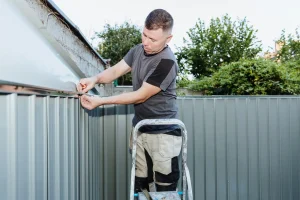
Situations Where a Slope May Prevent Installation
A slope may prevent installation when the grade is steep enough that a stable foundation would require excessive correction. This includes situations where the required support height becomes impractical, where soil cannot reliably hold base material, or where drainage cannot be controlled.
Unstable or saturated soil can also limit feasibility. Indicators include visible erosion, standing water, or shifting ground. Even if the slope appears manageable, these conditions can prevent long term stability.
Access can be a separate limiting factor. A site may support a shed structurally but still be unsuitable if delivery equipment cannot reach the location safely due to slope, obstacles, or restricted pathways. In some cases, repositioning the shed within the property may be a viable alternative before ruling out installation entirely.
Preparing a Sloped Yard for Shed Delivery
Preparing a sloped yard begins with confirming the exact placement area and measuring the grade across the full footprint. This ensures the foundation plan reflects actual site conditions rather than assumptions.
The installation area must be cleared of vegetation, debris, and loose material. Base preparation should be completed and stabilized before delivery. If the base is not ready, the shed may not sit level, which can lead to structural issues or require rescheduling.
Preparation also includes planning the delivery route. Access paths, gate widths, overhead clearance, surface firmness, and slope transitions must be evaluated. A yard may be suitable for the shed itself but still require adjustments to allow safe and controlled delivery.